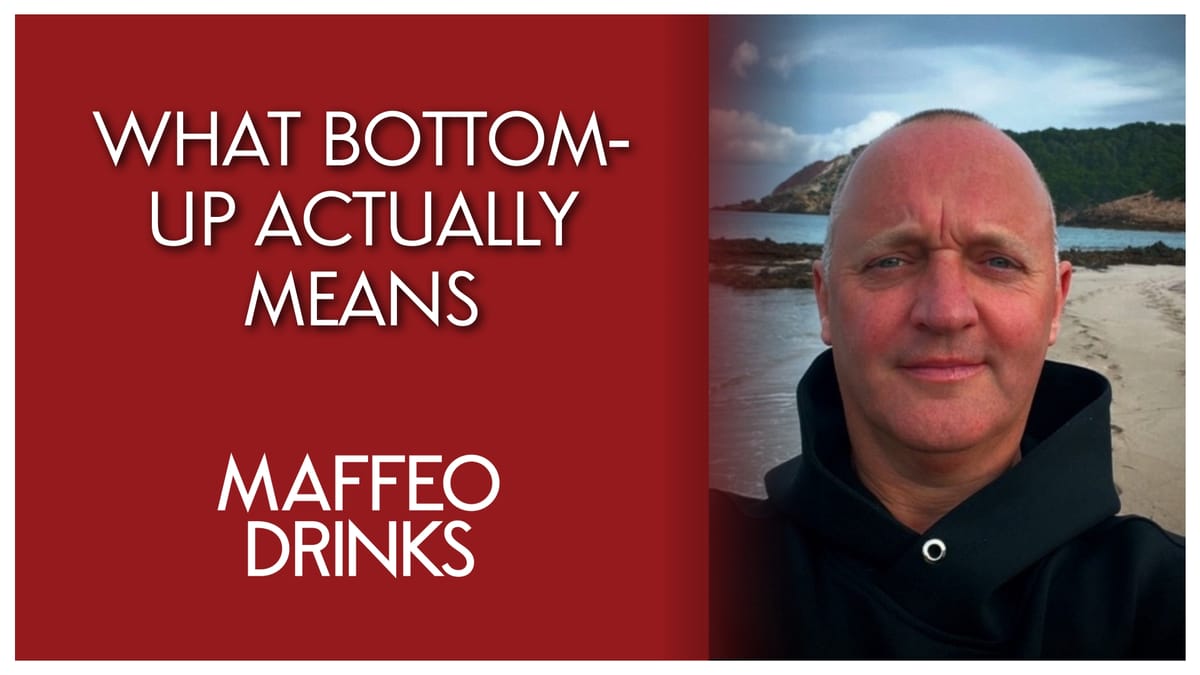
What Bottom-Up Actually Means: Mark Ward, Founder of Regal Rogue on the Behaviour Between One and Ten
From The MAFFEO DRINKS Podcast: Mark Ward reveals why the gap between what you think you're saying and what the market actually hears burns more budget than any failed campaign.
Your field team just hit ten accounts.
You're celebrating the milestone while missing the actual work: understanding what happened between account two and account ten.
That behavior between milestones is what bottom-up actually means.
Most brands never study it.
The Patterns Burning Budget
You celebrate hitting distribution targets without understanding the behavior that got you there.
You can't replicate success because you never identified what actually worked between the milestones.
Your message isn't connecting but you're perfecting transmission instead of verifying reception.
The founder who succeeded with their last brand is struggling with this one because the behavior between one and ten is completely different.
You feel like you're going in circles when you might actually be spiraling upward (or burning budget while thinking you're progressing).
That celebrity partnership worked for your competitor but failed for you because you copied the visible tactic without the invisible behavior.
These aren't separate problems. They're the same pattern: skipping the behavior between milestones while celebrating the milestones themselves.
Listen to the episode :
What Building Bottom-Up Actually Means
Mark Ward has run Regal Rogue for 15 years after working both sides (owned his own bar, then worked global brands). His definition of bottom-up reveals what most brands completely miss.
"Bottom-up for me is how you turn one into ten, ten into a hundred, a hundred into a thousand. It's getting out there and trying to understand what it involves when you get past two, and what the behavior in between is."
The work isn't achieving ten accounts. It's understanding what happened between account two and account ten. That's where the actual learning lives. That's where you discover what actually works versus what you assumed would work.
Most brands celebrate hitting ten accounts without studying the behavior that got them there. They can't replicate it because they never understood it in the first place.
"There's a dynamic in the business where ten becomes a hundred, but you're only in the two to ten venues or focusing on the two to 10th bib."
The behavior changes at different scales. What works from one to ten doesn't automatically work from ten to a hundred. But you can't discover the new behavior if you never understood the first behavior.
This isn't about growing slowly.
It's about understanding the mechanics of how growth actually happens at each stage.
Why This Moral Exists
This isn't a recap of Mark's journey building Regal Rogue. This is the systematic pattern visible across brands that celebrate milestones while ignoring the behavior between them.
Everyone sets distribution targets. Everyone celebrates hitting those numbers. But almost nobody studies what actually happened in the middle. What worked between account two and account ten?
What changed when you went from ten to fifty? What broke when you tried to go from fifty to two hundred?
The brands that understand bottom-up study the behavior between milestones. The brands that fail celebrate the milestones without understanding how they got there.
After 15 years, Mark realized something most brands never discover: "I think most of the work is a constant check-in, an audit. The behavior in between, the engagement, the nurturing of the relationship."
This moral exists because knowing you want ten accounts isn't enough. Understanding the specific behavior required to turn one into ten, then ten into a hundred, is what separates brands building lasting foundations from brands hitting numbers that don't sustain.
Ready to understand what the behavior between milestones actually looks like? Discover how verification replaces assumption, why experience doesn't transfer between brands, what the 50 key accounts principle reveals about behavior, and how playing where people already play eliminates wasted effort.

If the above resonates, it's because you're living it.
You understand local matters. But you're making expansion decisions based on distributor enthusiasm or market size, rather than systematically identifying cultural fit.
I've spent 20 years observing what works across 30+ markets, 100+ founder conversations, and weekly field validation. What follows are the three predictable mistakes and the systematic approach for avoiding them.
Paid content for Drinks Leaders serious about their work. 👇🏻