Why You Must Think About One Case Before You Sell One Bottle
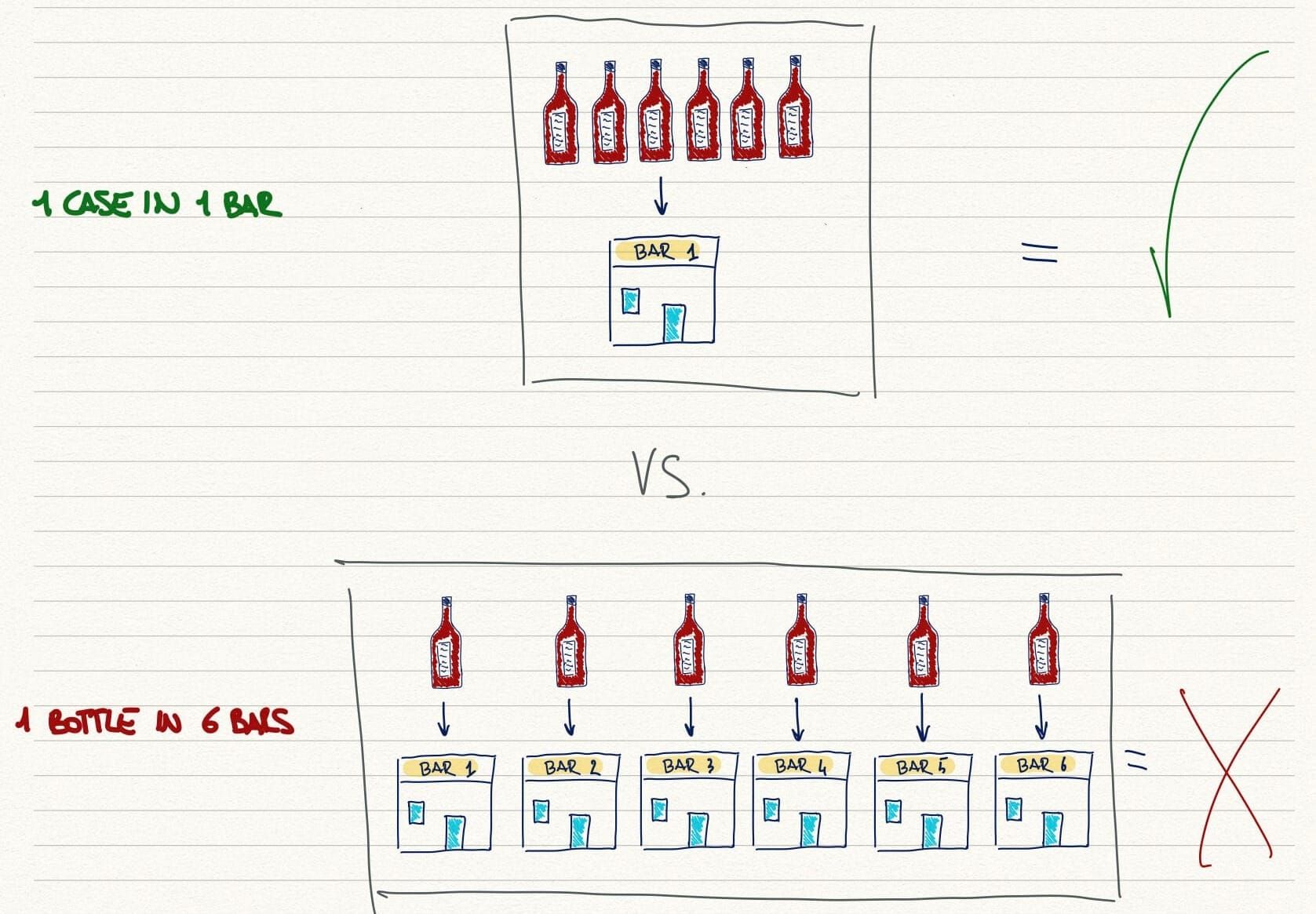
Let me tell you something obvious. Six bottles in one bar is better than one bottle in six bars.
You already knew that. I know you did. And yet this is the most debated thing I say publicly. Half the room agrees immediately. The other half pushes back before I finish the sentence. And a third group, the most interesting one, says: in theory, yes, but in practice it is much more complicated than that.
They are all right. Which is why the argument alone was never enough.
Here is what is actually happening when you place that first bottle:
The bartender said yes. You left the bottle. You updated your distribution count. In your head, you have a new account. In reality, you have opened a question. The question is simple: can this account, with the right support, sell this product? You do not know the answer yet. Nobody does. The bottle sitting on the back bar is not proof of anything. It is the beginning of a diagnostic.
Every first bottle opens a window. Inside that window you have one job. Not to find more accounts. To run the test. Does the bartender understand the product well enough to explain it to a customer in fifteen seconds? Is it visible somewhere on the menu, or is it just a bottle that nobody will order unless they already know it exists? Are you showing up, not to sell, but to listen?
This is the work. It is not glamorous. It is exactly what most brand people skip because they are already thinking about the next door to knock on.
When the diagnostic runs correctly, the account reorders. That is a yes. When it does not, that is information. Most brands treat the non-reorder as a dead account. It is not. It is telling you something. Rarely is the problem the account. Almost always, it is the work that did not happen inside the window.
I had this conversation recently with someone sharp in the industry. His question was the one I hear constantly: Don't you need more accounts to find the ones that can actually move volume? My answer was no. And then he pushed back, as most people do. And he was right to.
Some brands have product clarity. Their product already knows where it belongs. When they place the first bottle, the right accounts recognise themselves in it almost immediately. The diagnostic window is short because the fit is obvious. Most brands do not have that yet. And the mistake they make is confusing a brand clarity problem with an account selection problem. They go wide to discover the right accounts. What they are actually doing is asking the same unanswered question in more places and paying more for the privilege.
Width does not solve clarity. It scales the silence.
And here is the other mistake, the one that burns everything before it starts. Going into two hundred accounts at once. The feedback loop only works if the loop is small enough to close. Ten to fifteen accounts is enough signal to understand what is working and what is not. Enough to fix the product story, the timing of your visits, the cocktail suggestion, before you scale any of it.
I think of it like an accordion. You open. You place the bottles, you expand into new bars. Then you close. You go deep, you run the diagnostic, you earn the reorder. In between the opening and the closing, you play the music. Then you open again, wider, because now you know what you are doing.
The pushback I kept hearing, " Yes, but in practice it is harder than that", is exactly what made me build a framework around this. Because the argument is simple. The execution is where it falls apart.
I turned this into a step-by-step framework. The accordion model. The account ceiling. The three diagnostic checks. The reorder as the decision point. You can find it inside the Lab.
If you want the how-to, it is below:

Member discussion