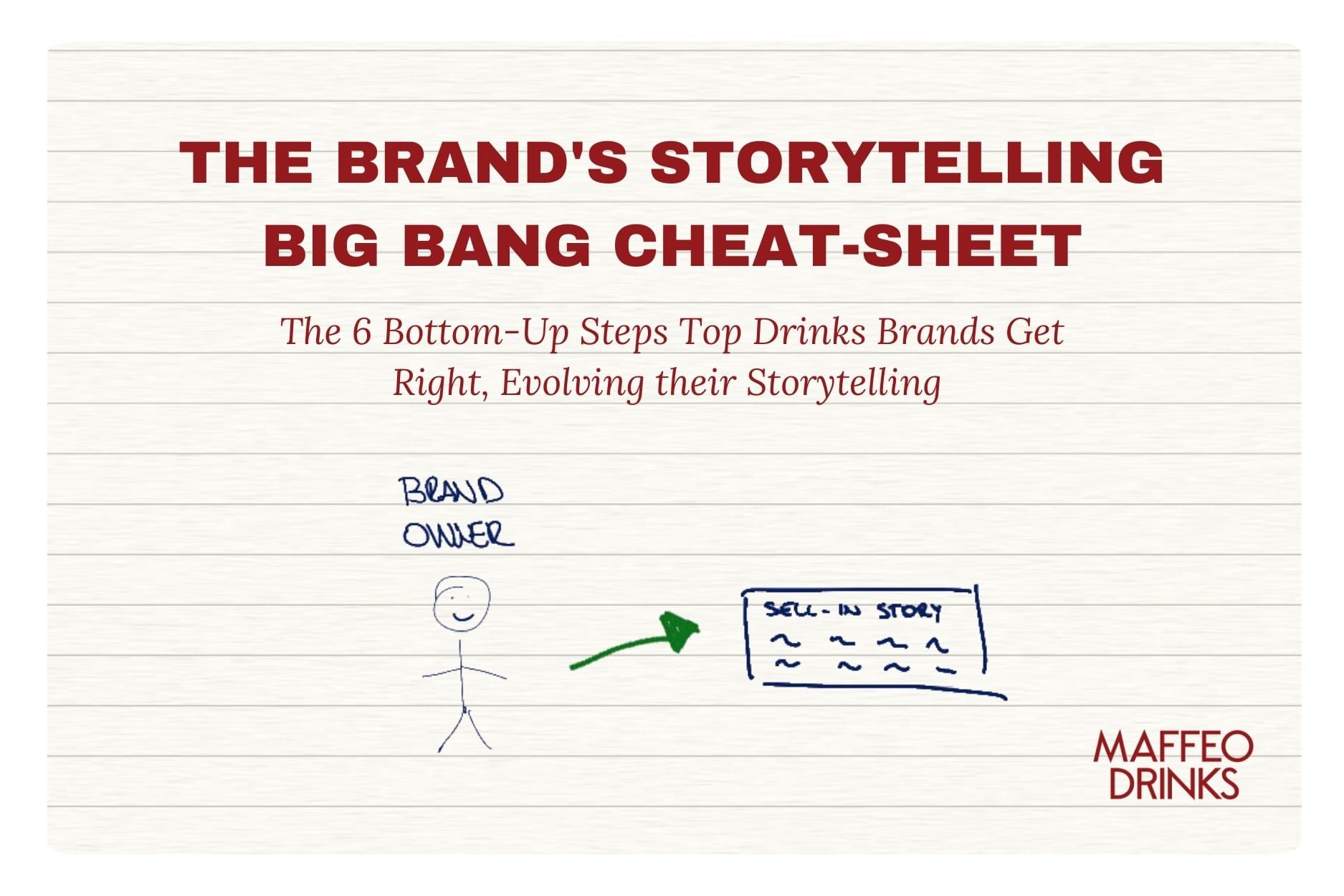
The Brand's Storytelling Big Bang Cheat Sheet: 6 Bottom-Up Steps to Build Brands That Last (Before You Waste Your Budget on a Logo, Bottle, and Story That Don't Connect)
What My Conversation with Steven Grasse Revealed About Building Hendrick's and Sailor Jerry (That Will Save You $100K in Useless Brand Assets)


Dear Drinks Builder,
There's a pattern I see repeatedly with struggling drinks brands. They spend months perfecting a logo. They agonize over bottle shape. They craft an elaborate origin story.
Then they launch and wonder why nobody cares.
The problem isn't effort. It's that they build in a disconnected way. They create a liquid, then hire someone to make it look good. Logo first.
Bottle shape. Maybe a backstory. But none of it feels connected because it wasn't conceived together.
The liquid says one thing, the packaging says another. By the time they realize the mistake, the budget is gone.
I've spent twenty years building brands across thirty markets, and I've watched this pattern destroy promising products over and over.
So when I sat down with Steven Grasse for Episode 027 of The MAFFEO DRINKS Podcast, I wanted to test whether his experience creating Hendrick's Gin and Sailor Jerry Rum aligned with what I've observed.
What emerged confirmed something uncomfortable: most of what passes for brand building in our industry is backwards.
Consider the timeline problem. Hendrick's took ten years to build. Ten years of systematic work without data proving it would succeed.
Monkey Shoulder nearly got killed because the numbers didn't look right. It survived only because someone in the field noticed that a demographic thirty years younger than expected was drinking whisky cocktails in ways nobody was measuring.
Most brands don't survive long enough to find out if they're working. They get killed by impatient stakeholders reading the wrong metrics, or they expand too fast and scatter their resources across markets they can't properly service, or they sign distributor agreements that trap them in relationships with partners who don't care whether they succeed.
Then there's the research trap. Brands commission studies to avoid making decisions, then wonder why everything they launch feels safe and forgettable. When Hendrick's went through a focus group, everyone irresistibly grabbed the bottle, then said they hated it.
The brand exists because someone trusted the grab over the words. Most companies would have killed it based on the stated feedback.
And the internal boredom problem.
Brand managers who've been talking about the same positioning for two years want something fresh. So they "evolve" the brand, which usually means diluting whatever made it distinctive.
Meanwhile there are always new consumers entering the category who've never heard the original story, and they need consistency, not novelty.
These traps are predictable. They're also avoidable, but only if you understand the methodology that actually builds brands over time rather than the shortcuts that kill them.
What follows is the approach I've developed and refined over two decades, validated by conversations with practitioners like Grasse who've actually built brands that last. It's not theory. It's pattern recognition from the field.
If the above resonates, it's because you're living it.
You know the commercial problem is real. You just cannot see exactly where it starts.
I built a diagnostic for this. Two weeks. A complete picture of your commercial situation. A report you can act on immediately.
Commercial X-Ray, starting at €5,000.
If it's not the right time yet, you can subscribe to the Lab at €500 per year👇🏻
Subscribe to continue reading